
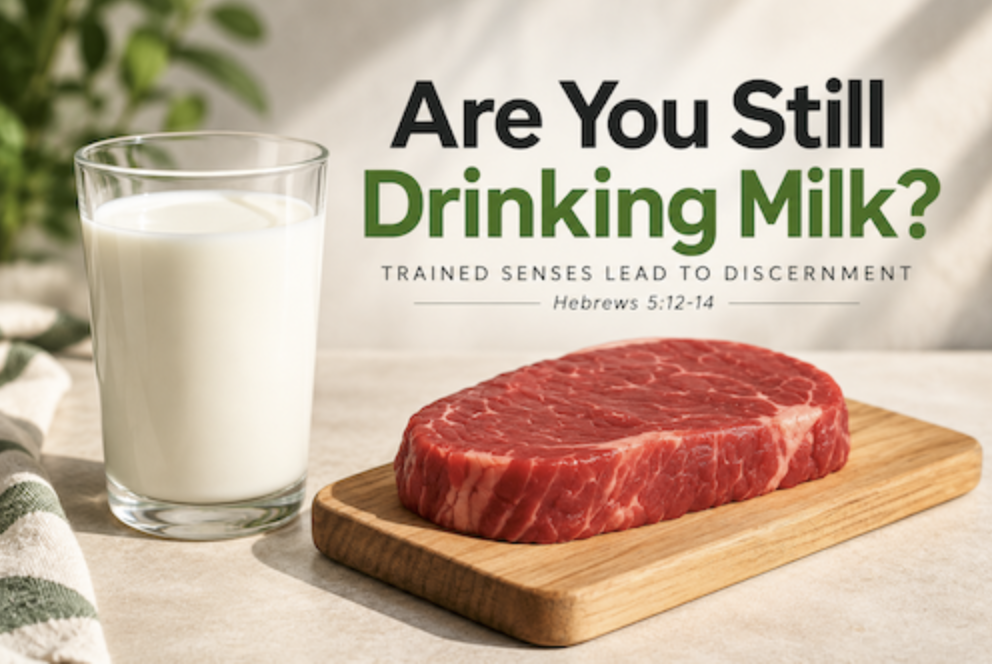
There is a passage in Hebrews that has challenged me for years because it gives us a very different picture of spiritual maturity. We often think Christian maturity means knowing more Scripture, receiving more revelation, or understanding more truth. Hebrews points us toward something deeper.
The writer tells believers that by this point they ought to be teachers, but instead they still need someone to teach them the elementary truths of God’s Word. Then he makes this distinction between milk and solid food:
“But solid food belongs to those who are of full age, that is, those who by reason of use have their senses exercised to discern both good and evil.”
Hebrews 5:14, NKJV
Notice what Hebrews does not say. It does not say maturity belongs to the person who has heard the most sermons, accumulated the most information, or can explain the most doctrine. It says solid food belongs to those who by reason of use have their senses exercised to discern.
That phrase has become very important to me: by reason of use.
Truth has to become something we use.
You can know what Scripture says about fear and still allow fear to interpret your circumstances. You can know what Scripture says about trust and still spend your day rehearsing everything that could go wrong. You can know that God is your provider while continually training yourself to expect lack.
At some point, what we know has to begin changing the way we respond.
Your Senses Are Being Trained
We often think about our senses simply as sight, hearing, touch, taste, and smell. But Scripture gives us a much larger picture of discernment. We are constantly receiving information from our environment, interpreting that information, and responding to what we believe it means.
That means our experiences are teaching us.
If disappointment happens repeatedly, I may begin expecting disappointment before anything has actually gone wrong. If pain has been present for a long time, I may begin approaching movement with caution before I have even moved. If relationships have repeatedly hurt me, I may become suspicious of people who have never harmed me.
The experience may have ended, but the expectation it formed can remain.
This is one reason I believe spiritual maturity requires more than acquiring information. Our senses must be trained. We have to learn to recognize what is shaping the way we interpret what is happening around us.
Hebrews says this training happens through use.
We practice truth until truth begins influencing our response.
What Has Been Training You?
All of us are being formed by something.
Our environment speaks to us. Our experiences speak to us. Our emotions give us information. Memories can influence what we expect next. Fear can take a possibility and present it to us as though it were already a certainty.
None of this means emotions are bad. Emotions are valuable. They tell us something about how we are interpreting what is happening. The problem begins when an emotion that was meant to give us information becomes the authority that tells us what is true.
Fear can become a teacher. Disappointment can become a teacher. Pain can become a teacher. Past experience can become a teacher.
And if I repeatedly respond according to what those teachers are telling me, I am exercising my senses—but I may be exercising them in the wrong direction.
This is why maturity is not simply about whether you have feelings. The question is: What are you allowing to train your expectations and responses?
Milk and Solid Food
Milk is necessary at the beginning. There is nothing wrong with milk when you are supposed to be drinking milk. The problem in Hebrews is that people who should have matured were still dependent upon someone else to continually tell them what was true.
They knew truth, but they had not learned to use it.
Solid food belongs to the person who has practiced.
This changes how I think about spiritual growth. Maturity is not demonstrated simply by how much revelation I can receive. Maturity becomes visible in what happens after revelation comes.
Can I recognize fear without allowing fear to become my teacher? Can I experience disappointment without letting disappointment write my theology? Can I notice pain without immediately allowing pain to decide what my body is capable of doing? Can I hear the Holy Spirit and respond to what He is saying even when my previous experiences are telling me something different?
That is training.
We are learning to recognize what is speaking, discern what is true, and respond accordingly.
When Worry Becomes Meditation
There is a moment in Mark 8 that I keep coming back to.
Jesus and His disciples are crossing the lake when someone realizes they forgot to bring bread. There is only one loaf in the boat, and the disciples begin reasoning among themselves because they have no bread.
It is such an ordinary problem. They see what they have, recognize that it is not enough, and immediately begin thinking about the lack.
But there is one extraordinary detail.
Jesus is in the boat.
The same Jesus who had already fed thousands of people with a handful of loaves was sitting beside them. They had personally witnessed provision that could not be explained by the resources available to them.
They had evidence behind them. Yet the shortage in front of them became louder than the testimony behind them.
Jesus asks them a remarkable series of questions:
“Why do you reason because you have no bread? Do you not yet perceive nor understand? Is your heart still hardened? Having eyes, do you not see? And having ears, do you not hear? And do you not remember?”
Mark 8:17–18, NKJV
Then He reminds them of the loaves.
Jesus brings them back to what they had already experienced.
That is important because worry has a way of narrowing our attention until the problem in front of us becomes the only evidence we are considering. We rehearse it. We analyze it. We imagine what could happen. We try to solve every possible outcome.
In that sense, worry can become a form of meditation. We repeatedly turn the same information over in our minds until it begins shaping our expectation.
The disciples were meditating on one loaf while sitting beside the One who multiplies bread.
Their problem was real. Their conclusion was incomplete.
Remembering Retrains Expectation
Jesus did not tell the disciples to pretend they had more bread than they had. He reminded them that their present circumstances were not the only information available to them.
They also had testimony. They had memory. They had experienced the faithfulness of God.
This is one reason remembering is so important throughout Scripture. What God has already done becomes evidence we can bring into the way we interpret what is happening now.
Fear says, Look at what might happen.
Memory says, Remember what God has done.
Fear trains us to anticipate danger. Testimony trains us to recognize faithfulness.
This is where Re-Formation begins to become practical. We are not denying what happened to us or pretending difficult circumstances do not exist. We are learning to recognize when an old experience has become the lens through which we automatically interpret a new moment.
Then we bring truth into that interpretation.
Over time, our senses can be exercised differently.
The Holy Spirit Is Our Teacher
Jesus did not leave us alone to accomplish this through self-discipline.
The Holy Spirit teaches us.
Jesus told His disciples:
“But the Helper, the Holy Spirit, whom the Father will send in My name, He will teach you all things, and bring to your remembrance all things that I said to you.”
John 14:26, NKJV
He reveals. We respond. And through repeated response, what we once only understood intellectually begins becoming part of the way we live.
This is why I want people to learn to recognize His voice in ordinary moments, not only dramatic ones. Spiritual maturity is formed in the small decisions where we notice what is influencing us and choose how we will respond.
Sometimes the practice is choosing trust when fear has already constructed an entire future in your imagination. Sometimes it is remembering what God has done when disappointment is telling you nothing will change. Sometimes it is extending kindness when an old wound tells you to protect yourself. Sometimes it is moving when fear tells you to remain guarded.
These moments may seem small, but they are exercises.
And exercised senses become discerning senses.
Maturity Changes the Direction of Influence
There is another reason this matters.
Hebrews tells these believers that by this time they ought to be teachers.
In other words, maturity was never supposed to end with them.
When we are immature, our environment continually tells us how to respond. Circumstances change, and we change with them. Someone treats us badly, and our peace disappears. Something frightening happens, and fear becomes our authority. Pain appears, and immediately our attention and expectation organize themselves around pain.
But as our senses are trained, something begins to change.
Instead of merely being formed by our environment, we begin to discern what we encounter and bring what God has formed in us back into our environment.
This is why Paul can say:
“Pursue love, and desire spiritual gifts…”
1 Corinthians 14:1, NKJV
The gifts of the Spirit are not simply experiences for us to collect. They allow what God is doing in us to become something that strengthens someone else.
Someone needs encouragement. Someone needs wisdom. Someone needs comfort, healing, or hope. Someone needs to know that God sees them.
When fear has trained me to protect myself, I walk into a room wondering what could happen to me. Love allows me to enter the same room asking a different question: Holy Spirit, what do You want to do through me?
That changes the direction of influence.
What He teaches us, we learn to live. What we live begins forming us. And what He forms in us eventually becomes something we can carry into the lives of other people.
That is maturity.
Don’t Just Learn It. Practice It.
I don’t want you to finish this teaching simply agreeing with it. If Hebrews is right, agreement alone will not train your senses.
Use will.
For the next seven days, begin noticing what has been teaching your expectations. Pay attention to the moments when fear, disappointment, pain, or an old experience tries to interpret something before you have had an opportunity to discern it.
Then invite the Holy Spirit into that moment.
Ask what is true. Remember what God has already done. Listen for His direction. Practice responding differently.
You do not have to manufacture a dramatic spiritual experience. You are simply learning to use what God has already given you.
At the end of each day, take a few minutes and consider: Where did I notice something good today? Where did I sense the Holy Spirit’s direction, and how did I respond? Where did an old emotion or expectation take the lead before I noticed it? What can I practice differently tomorrow?
Then do it again.
This is how senses are trained. This is how truth moves from something we know to something we live.
And perhaps that is the question Hebrews is asking all of us:
Are we still drinking milk, or have we begun to use what we have been given?
— Ravi Kandal
Continue Your Healing Journey
Join Nurturing Wisdom — weekly teaching and mentoring with Ravi Kandal.
Join Nurturing Wisdom
Book a Freedom Call — a personal conversation with Ravi to help identify what may be keeping you stuck and determine your next step.
Book a Freedom Call